
Lamb County Court Records After Arrest
After a Lamb County arrest, the jail record and the court record do not serve the same job. The Lamb County Jail record is a custody record, and the official Lamb County Sheriff page identifies Sheriff Gary Maddox as the local sheriff. A jail record can document booking, arresting agency, early charge labels, holds, bond status, and release or transfer status. The court record is the filed criminal case. It can contain the complaint, information, indictment, docket entries, motions, orders, hearing settings, dispositions, sentence terms, and appeal activity. The split matters because a person can be booked before the prosecutor has made a final charging decision.
The Lamb County & District Attorney's Office is the charging office identified in the research. Its official page says the office prosecutes criminal offenses in Lamb County from Class C misdemeanors to capital felonies, including juvenile matters, and represents the State in appeals. It also says the office does not investigate complaints. Law-enforcement agencies investigate and present completed cases for charging review. That is why a jail booking may appear before the matching court record is easy to find. For the custody and booking side, use Lamb County jail inmate records. For photo-specific records, use Lamb County jail mugshots.
Lamb County Prosecutor Role
The prosecutor role is central to court records after a jail arrest because the prosecutor decides how the arrest moves into the court file. Police or deputies may list an arrest charge at booking, but the filed charge may be different after review. A prosecutor can file the same charge, add charges, reduce a charge, reject a charge, or present a felony matter to a grand jury. The County & District Attorney's Office also warns that some current or past prosecution and investigation information must remain confidential by law.
The official Lamb County & District Attorney page identifies Rickie R. Redman as County & District Attorney and lists the office at the courthouse in Littlefield. The screenshot below is useful because it shows the local prosecution office rather than a generic state agency.
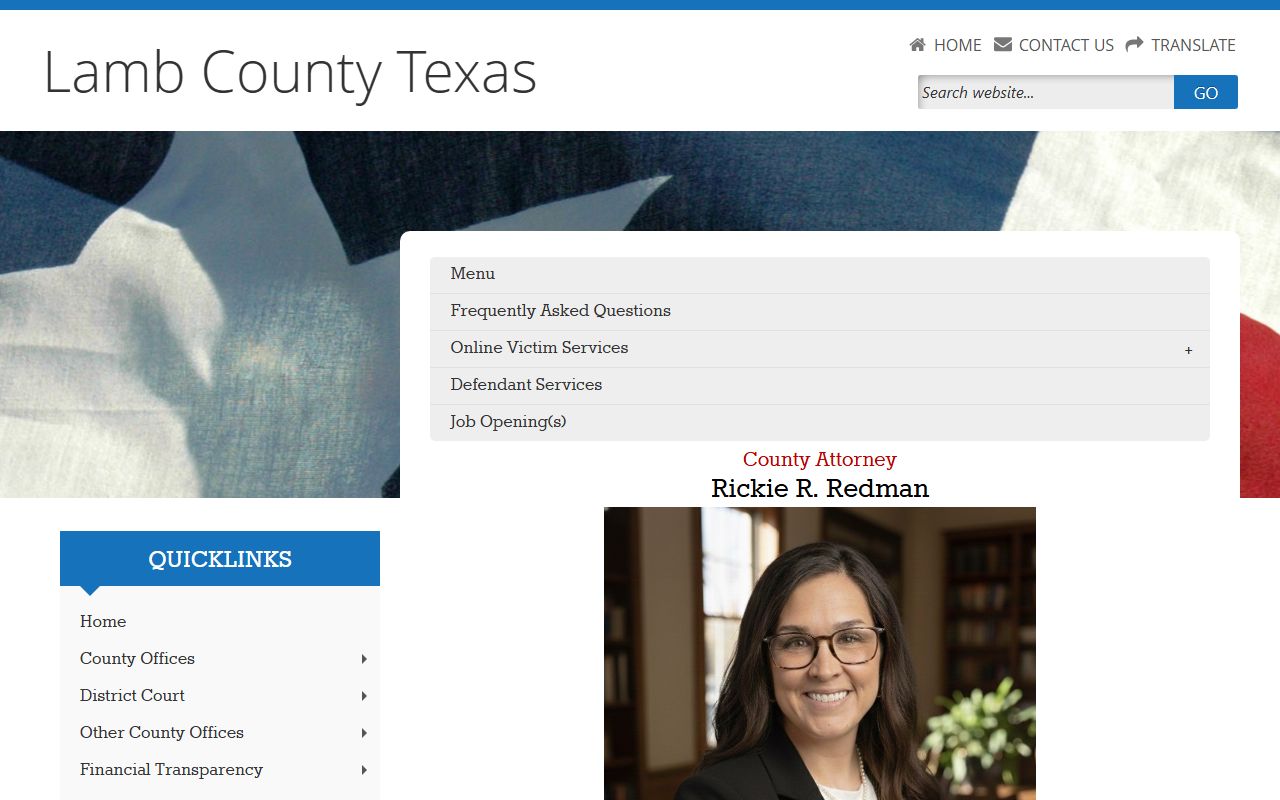
Use the prosecutor page for role and victim-assistance context, not as a public case file. Court records and file copies route through the clerk for the court where the case is filed.
Lamb County Clerk Routing
Clerk routing depends on the court level. The District Clerk is the usual route for district court and felony criminal records. The County Clerk is the usual route for county-level criminal records, including many misdemeanor records. Both offices are at 100 6th Drive in Littlefield, but they are not interchangeable. A felony indictment, a county-level misdemeanor information, and a payment question may each point to a different desk.
| Office | Use For | Contact From Research |
|---|---|---|
| District Clerk | District court and felony case records | Debbie Long, Room 212, (806) 485-0071 |
| County Clerk | County-level criminal records and county records | Rene Trevino, Room 103, (806) 485-0053 |
| County & District Attorney | Charging decisions, prosecution, victim assistance | Rickie R. Redman, Room 210, (806) 485-0049 |
The County Clerk page also lists a Certified Payments bureau code for criminal web payments. Treat that as a payment clue, not as proof of a public case-search system. If the case number is unknown, start with the person's name, arrest date, and whether the charge seems felony or misdemeanor.
Search re:SearchTX Court Records
re:SearchTX is the statewide court-record search portal noted in the Lamb County research. It can be a first search path for court records after an arrest, but access depends on court participation, registration, user role, and document restrictions. If a Lamb County case is not found there, contact the District Clerk or County Clerk directly rather than assuming no case exists.
| Field | Type | How to Use It |
|---|---|---|
| Search term or party name | Text | Use the defendant name, with exact and partial variants. |
| Case number | Text | Best when known from bond paperwork, notice, or clerk receipt. |
| Location or county | Filter | Narrow to Lamb County when the portal permits it. |
| Case category | Filter | Use criminal, felony, or misdemeanor options when available. |
| Date range | Filter | Helpful for recent arrest-to-filing searches. |
The re:SearchTX court search page is shown below as the statewide search entry point for filed court records.
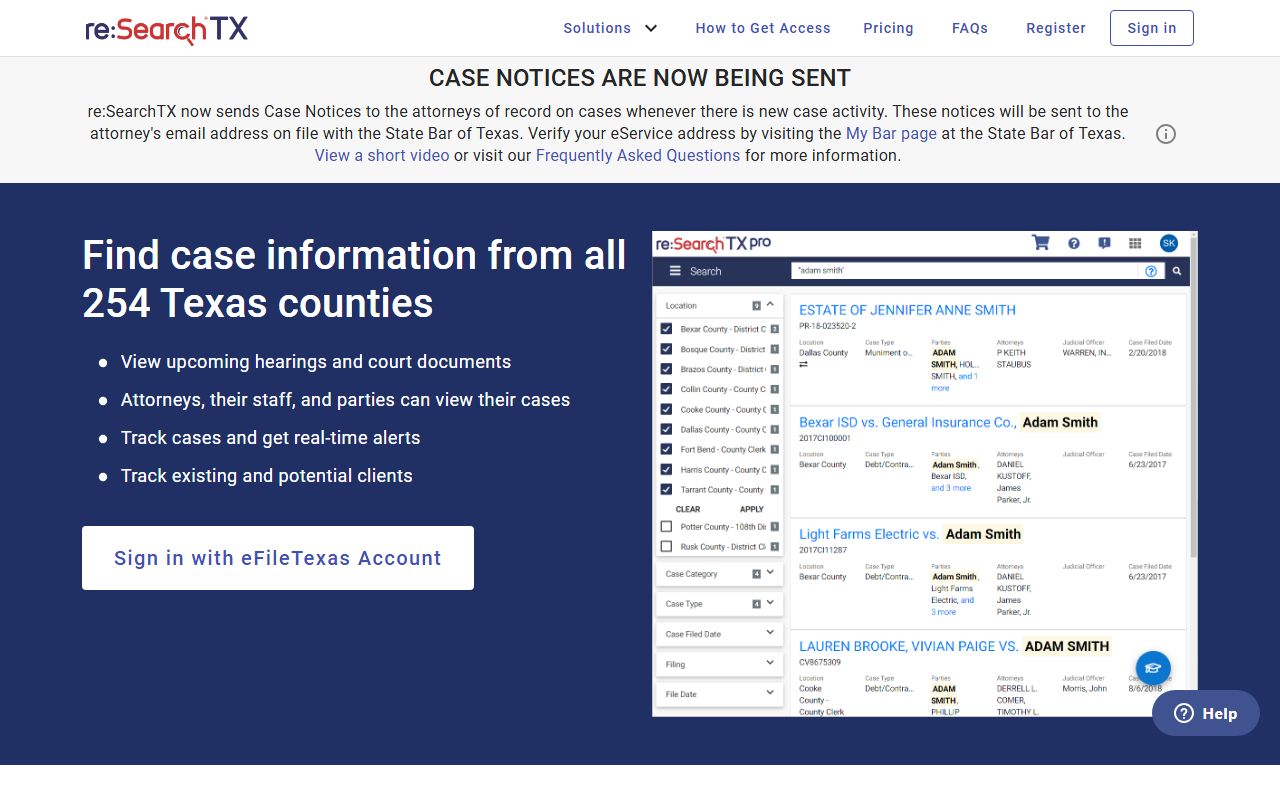
The portal is a search tool, not the whole record system. Clerk offices remain the direct custodians for many file questions, certified copies, and case-specific access limits.
Lamb County Charging Documents
The first filed paper can define the case far more than the booking label does. A complaint, information, or indictment tells the court what offense the State is pursuing and gives the defendant a case to answer. In Texas practice, the document used depends on the charge level and court path. The names are easy to mix up, so the key point is simple: the filed document is part of the court record, while the booking entry is part of the jail record.
| Document | Who Uses It | What It Means |
|---|---|---|
| Complaint | Law enforcement or prosecutor | A sworn accusation that may begin the criminal process or support a warrant. |
| Information | Prosecutor | A formal charging paper often used for misdemeanor cases and some felony contexts. |
| Indictment | Grand jury | A felony charging instrument returned after grand-jury review. |
A person can have more than one charging document across the life of a case. A complaint may be followed by an information, or a felony matter may move toward indictment. Read the latest docket and disposition before treating a charge as current.
Lamb County Charge Status
Charge status terms show where each count stands. They also show why court records after a jail arrest must be read by charge, not just by case caption. One case can have a pending charge, a dismissed charge, and an amended charge at the same time. Booking charges may also differ from filed charges because the prosecutor reviews the evidence after the arrest.
| Status | Plain Meaning | Reader Caution |
|---|---|---|
| Pending | The charge has been filed and is not yet resolved. | Check for the next hearing and bond terms. |
| Amended or reduced | The prosecutor or court changed the charge. | The booking label may now be outdated. |
| Dismissed | The charge ended without a conviction on that count. | Other counts in the same case may remain active. |
| Disposition | The final result, such as plea, verdict, dismissal, or sentence. | Read the exact docket entry or judgment. |
| Indictment | A grand jury returned a felony charging instrument. | It is a charge, not a conviction. |
Bond After Lamb County Arrest
Bond usually enters the record at or near first appearance. Texas Code of Criminal Procedure Chapter 17 controls bail and bond rules, including Article 17.15 factors. The court must set bail high enough to give reasonable assurance of appearance, but bail is not supposed to be used as an instrument of oppression. Courts also consider the nature of the offense, ability to make bail, and future safety of the victim and community.
| Bond or Hold | How It Affects Release |
|---|---|
| Cash bond | The full amount is posted as directed by the jail or court. |
| Surety bond | A licensed bail agent posts bond under Texas commercial bail rules. |
| Personal bond or PR bond | Release is based on a promise to appear, often with conditions. |
| No-bond hold | Ordinary payment will not clear release until a court changes the status. |
| Detainer or outside hold | Another agency may keep the person in custody even after local bond is posted. |
Lamb County did not publish a local bond desk page or bond schedule in the official sources reviewed. Confirm current custody and bond status through VINELink and the sheriff at (806) 385-7900, then ask whether payment routes through the jail, the clerk, a licensed surety, or a later hearing.
Lamb County Arrest Warrants
No official Lamb County active-warrant search or most-wanted list was located on the county site during the research pass. That means warrant checks are a phone-and-clerk task rather than a simple online roster task. The sheriff's main number is the local route for warrant and custody questions. The District Clerk and County Clerk are the better route for case-specific bench warrants or capiases tied to filed court records.
Texas Code of Criminal Procedure Chapter 15 governs arrest-warrant procedure. An arrest warrant is different from a search warrant. A bench warrant or capias often comes from a missed court date, failure to comply with an order, or other court event. A fugitive or out-of-county warrant can also create a hold at Lamb County Jail, which may delay release after a local bond is posted.
Charges Versus Convictions
A charge is an accusation. A conviction is a court result after a plea, verdict, or other judgment. Court records after a jail arrest may show both, but they should never be treated as the same thing. This is most important for background checks, employment decisions, housing decisions, and any setting where legal consequences depend on the final disposition.
| Point | Charge | Conviction |
|---|---|---|
| Stage | Accusation filed by the State | Final court result on an offense |
| Proof level | Based on charging standards and probable cause | Based on plea or proof beyond a reasonable doubt |
| Record effect | May remain visible unless restricted | May affect sentence, supervision, and later consequences |
Sealed or Expunged Records
Texas uses expunction and nondisclosure concepts. Expunction under Code of Criminal Procedure Chapter 55 can remove eligible criminal records in defined situations. Nondisclosure is a sealing-type order that limits public access, but it is not the same as destroying the record. Eligibility depends on the charge, disposition, timing, prior history, and statute. A dismissal alone does not always mean the record has vanished from every public system.
| Record Result | Public Access | Basic Meaning |
|---|---|---|
| Nondisclosure or sealed | Limited from ordinary public view | Some agencies may still have access under law. |
| Expunged | Removed or destroyed under court order | The eligible arrest record is treated as cleared under the order. |
| Not restricted | May remain public | Clerk and law-enforcement access rules still apply. |
Lamb County Public Access Limits
Texas Government Code Chapter 552, the Texas Public Information Act, gives the public a way to request government records unless an exception or confidentiality law applies. Law-enforcement information can be limited by Government Code 552.108. Subsection 552.108(c), however, preserves access to basic information about an arrested person, an arrest, or a crime. In practice, this means some basic arrest information may be public while active investigation details, juvenile records, victim information, medical or mental-health information, and confidential prosecutor material may be withheld or redacted.
Important: Court records after an arrest are not consumer reports, and casual lookups should not be used for FCRA-covered decisions.
For the best result, ask the correct custodian for the exact record. The sheriff handles jail and booking records. The clerks handle filed court records. The prosecutor handles the State's case work but may not release non-public prosecution material. If one route fails, use the next custodian rather than treating the search as finished.